Strategic architecture
for human and
business value.
Director-level product leader with 20 years of experience navigating complex organizational systems, leading cross-functional teams, and executing high-fidelity digital products.
The Methodology
Ecosystem Mapping
Charting the unseen organizational mechanics, data flows, and human dependencies that dictate user experience. Aligning product, engineering, and business leadership around a singular, actionable schema.
Strategic Artifacts
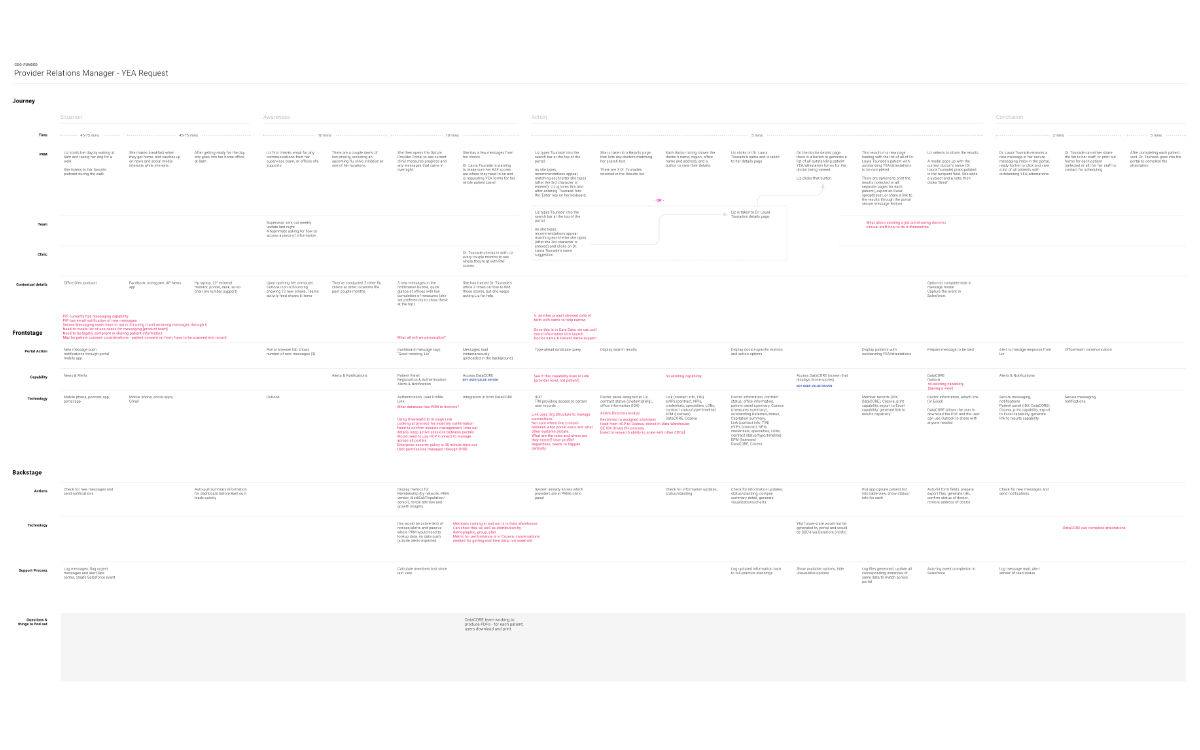
Service Blueprints · Value Stream Maps · Workflow Diagrams
Systems Thinking
Identifying the highest-leverage points of intervention within a complex architecture. Shifting focus from isolated features to the holistic operational flow to ensure sustainable business impact.
Strategic Artifacts
Leverage Point Analysis · Causal Loop Diagrams · Wardley Mapping
Velocity & Orchestration
Leveraging modern technical orchestration, including natural language models and AI agents, to accelerate iteration cycles, prototype complex logic, and deliver build-ready fidelity at scale.
Strategic Artifacts
AI Agent Workflows · Logic Schemas · Rapid Validation Prototypes
Selected Works
Clinical Data Portal
Unifying disparate health information to reduce cognitive load for care teams.
Quantified Experience
A predictive framework for measuring product success before capital is committed.
Unified Patient App
Consolidating nine siloed applications into a single, unified native mobile framework.
The Skill Grid
Transforming a diverse group of specialists into a resilient team of high-impact generalists.


The Architecture of Leadership
Trust is the foundational architecture of any high-performing team. It unlocks velocity, personal ownership, and the structural integrity required to navigate complex product lifecycles.”
Moving Upstream
In 2016, my operational focus shifted from high-fidelity execution to upstream systemic orchestration. Validated user data and usability metrics were consistently overridden by execution-focused timelines. To engineer a successful launch, intervention must happen before the build phase by aligning financial planning and stakeholder priorities.
System Telemetry
Executing a 100-mile endurance run requires rigorous telemetry: metabolic load, heart rate variability, and recovery protocols. When a system requires increased output, supporting structures must be fortified to prevent failure. This physiological framework strictly mirrors my approach to organizational architecture and team capacity.
The Human Element
No system functions without understanding the human variables operating within it. Informed by a background in music and creative disciplines, my approach to team development is rooted in observation. Fostering psychological safety allows diverse teams to fill structural gaps and achieve cohesive flow states.